
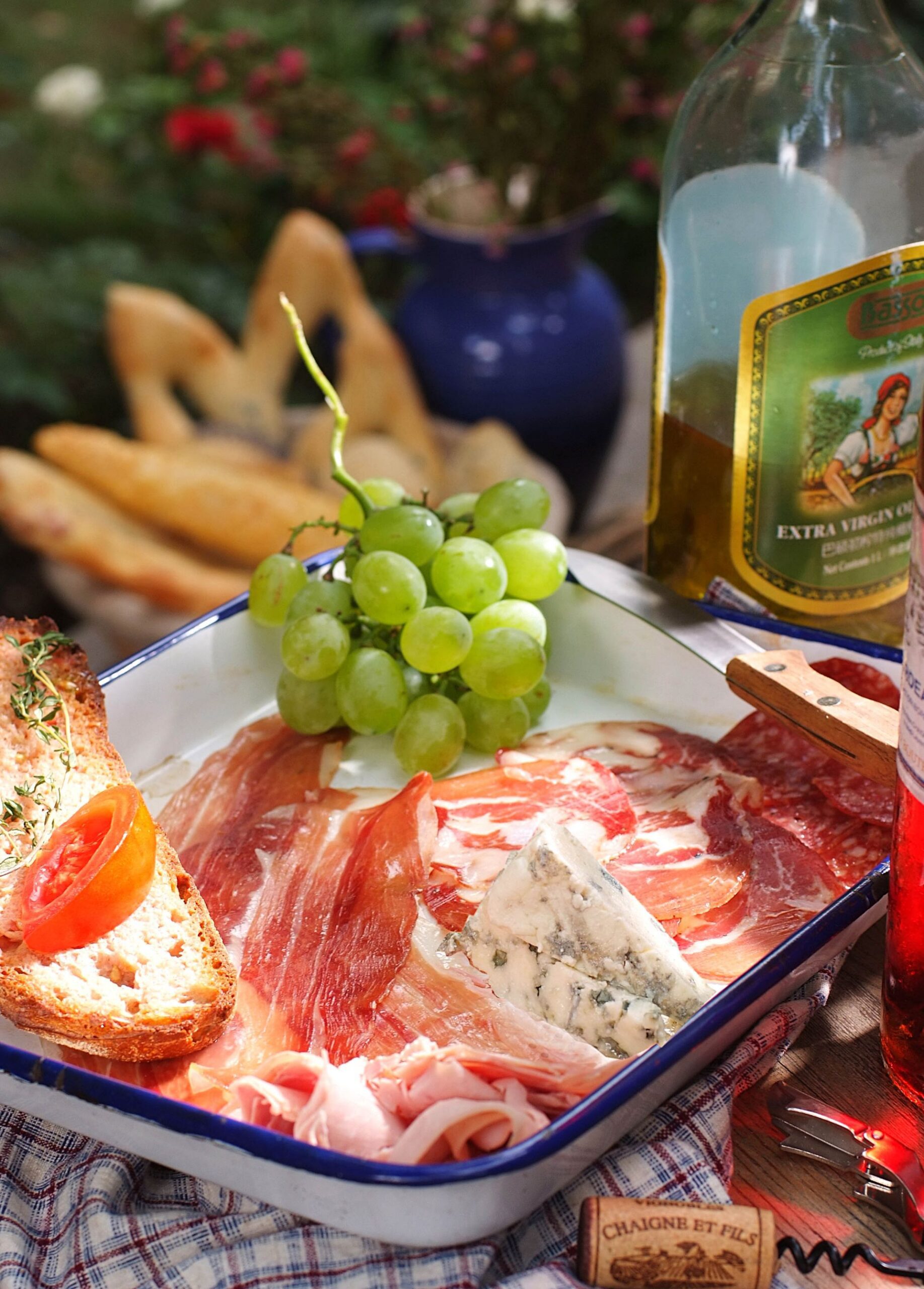
Almost every farmhouse across Spain and Portugal once kept a pig of its own — fattened through autumn, slaughtered at the first cold snap, and turned, cut by cut, into a year’s worth of protein that had to survive without a refrigerator. That single necessity became a craft, then a culture, then a source of quiet regional pride: a chorizo that only tastes right made one way in Rioja, a sausage that only earns its name inside one Catalan county, a leg of ham some families still won’t touch until it’s rested three winters in the same drying shed their grandfather used. None of it was ever meant to be eaten alone, either.
Jamón Ibérico de Bellota — The One Worth Waiting For
Everything else on this table is, in some sense, in conversation with Jamón Ibérico de Bellota. It comes from the black Iberian pig, a breed left to roam free across the dehesa — the oak-studded pastureland of southwestern Spain — where in autumn it eats almost nothing but acorns, the bellota the ham is named for. That diet is graded, not assumed: Bellota covers pigs raised free-range on acorns and pasture, Cebo de Campo a mixed diet of grain with some free grazing, and plain Cebo grain-fed pigs kept in more conventional conditions. Only the top tier gets to carry the name that made this ham famous.
After the leg is salted, it’s hung and left — two years at minimum, sometimes closer to three or four for the largest legs, curing slowly in mountain air until the fat marbled through the muscle turns almost translucent. Four Denominations of Origin hold the standard: Guijuelo in Salamanca, Jabugo in Huelva, Los Pedroches in Córdoba, and the Dehesa de Extremadura. Each one will tell you, not unreasonably, that its air cures the ham best.
Chorizo — Built Entirely Around One Spice
Take the pimentón out of chorizo and it stops being chorizo. Smoked Spanish paprika is what turns coarsely chopped pork and fat that deep brick-red, and whether a producer reaches for pimentón dulce (sweet) or picante (spicy) shapes the whole personality of the sausage before anything else even gets seasoned. Spain keeps hundreds of local versions going — Chorizo Riojano, thinner and built for La Rioja’s own table; Chorizo de Cantimpalos, cured in the hills outside Segovia; Chorizo de Pamplona, ground finer and packed thicker than most. Some get eaten sliced and cold; others are meant for the pan, where the paprika-stained oil left behind is arguably the point of cooking it at all.
Fuet — Catalonia’s Answer to Restraint
Where chorizo announces itself, fuet holds back. This thin, dry-cured Catalan sausage — the name means “whip,” after its long, slender shape — carries no paprika at all, just black pepper, garlic, and sometimes a whisper of aniseed folded through a mix of roughly 60% lean pork to 40% fat. It cures until a fine white mould blooms naturally across the casing, the same way a good cheese rind forms — a sign the sausage is doing exactly what it should. The finest is still tied to one place: Vic, in the Osona county north of Barcelona, where the mountain air has cured fuet for generations. Sliced thin, at room temperature, it needs nothing else.
Sobrasada — The Sausage You Spread, Not Slice
Sobrasada de Mallorca breaks every rule the others follow. It’s a raw, cured pork paste, soft enough to spread straight onto warm bread, built from minced pork, pork fat, salt, and a generous hand of pimentón — regulation actually requires it, right alongside black pepper and often rosemary, thyme, or oregano. It cures in drying sheds for up to six months, slowly losing moisture until the texture turns unctuous rather than firm. The most prized version comes from the island’s own black pig, the porc negre, held to even stricter standards than standard sobrasada. Its Protected Geographical Indication ties it to Mallorca alone — no other island, however similar its pigs, gets to use the name.
Morcilla — Not All Blood Sausage Is the Same
Morcilla is Spain’s blood sausage, and its most famous regional version, Morcilla de Burgos, is built around a combination almost no other Spanish morcilla shares: rice alongside the blood, onion, and pork fat. That rice is what sets it apart — it gives each sliced round a firm grain that fries clean and crisp rather than falling apart in the pan, best eaten in thick slices with something sharp alongside to cut the richness.
A Word for the Other Side of the Border
Portugal cures its own pigs with the same patience. Presunto, its answer to jamón, comes chiefly from two directions — Chaves in the mountainous north and the Alentejo in the south, where Presunto de Barrancos is cut from the Alentejano pig, the Portuguese cousin of Spain’s own black-footed breed. Linguiça and chouriço round out the Portuguese table, smoked and spiced along their own regional lines rather than borrowed from Spain’s.
On Our Table, Nothing’s Poured by Accident
Cured meat in Spain and Portugal was never eaten on its own, and it isn’t at our table either. A few pairings worth keeping close:
Jamón Ibérico de Bellota with Fino Sherry — a chilled, bone-dry Fino from Jerez cuts straight through the ham’s fat with saline, almost briny precision. It’s the pairing Andalusia settled on generations ago, and nobody there has found a reason to change it.
Chorizo Riojano with Rioja — smoked paprika and soft red fruit, from the same region, built for the same table. The wine’s gentle oak meets the chorizo’s spice evenly, neither one asking the other to step aside.
Fuet with Cava — two Catalan traditions, poured and sliced side by side. Cava’s bright acidity and fine bubbles clean the palate between bites of a sausage built on restraint rather than spice.
Sobrasada with a Binissalem Red — Mallorca’s own Denomination of Origin wine meets Mallorca’s own sausage. The red’s fruit and light tannin hold their ground against sobrasada’s richness without fighting it.
None of these pairings are rules handed down from anywhere official. They’re simply what generations at Iberian tables already worked out — ours just carries them forward.